Affiliate Disclosure: As an Amazon Associate, I earn from qualifying purchases.
Strategic Summary
- System Mechanics: Earthquakes are the sudden release of energy from “stuck” tectonic plates.
- Risk Variable: Your specific soil type (Bedrock vs. Landfill) determines the severity of shaking.
- Survival Gap: In a major event, you must be self-sufficient for at least 72 hours.
If you live in the United States, particularly along the West Coast or near the New Madrid zone, you are living on a dynamic landscape. Earthquakes aren’t just “accidents”; they are the mechanical byproduct of a planet in motion. To prepare effectively, you must first understand the system you are living in.
1. What Exactly is an Earthquake?
Our planet’s outer shell—the lithosphere—is broken into massive pieces called Tectonic Plates. These plates are constantly moving, driven by heat from the Earth’s core. An earthquake occurs when two blocks of earth suddenly slip past one another. The surface where they slip is called the fault or fault plane.
- The Sticking Point: Plates don’t slide smoothly. Their edges are jagged and rough. They get “stuck” while the rest of the plate keeps moving.
- The Elastic Rebound: Think of it like stretching a rubber band. Energy builds up in the rocks along the fault line.
- The Snap: When the force of the moving plates finally overcomes the friction of the jagged edges, the fault “snaps” and releases all that stored energy in waves.
2. Why Your Environment Matters: The “Fault” Reality
If your home is built near or on a known fault line, you are essentially “exposed” to a massive geological battery that is constantly charging. In the US, two major systems dominate the conversation:
- The San Andreas (California): A transform fault where plates grind horizontally. It is famous for high-intensity, localized shaking.
- The Cascadia Subduction Zone (Pacific Northwest): A “Megathrust” fault where the ocean floor is being shoved under the continent. This fault can produce Magnitude 9.0 $M_w$ events—the largest on Earth.
Why awareness is key: Different environments react differently to shaking. If your home is on solid bedrock, you may feel a sharp, quick jolt. If you are on soft soil or landfill, the ground can act like jelly, amplifying the shaking—a process called Liquefaction.
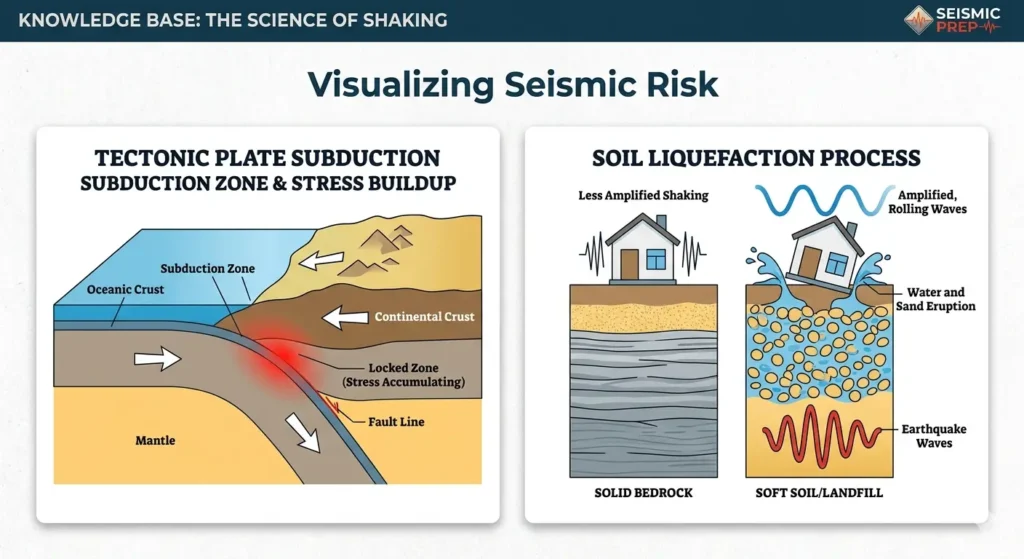
How tectonic subduction (left) creates waves that stay small in bedrock but grow dangerously large in soft soil (right).
3. The “Big One” vs. The “Next One”
Many people wait for “The Big One” (a catastrophic event), but smaller, more frequent quakes can be just as disruptive to a non-prepared home.
- The Infrastructure Gap: In a major event, “Just-in-Time” delivery systems for food and water will fail instantly.
- The Utility Snap: Water mains and gas lines are the first to rupture. This is why our 10-Minute Home Audit focuses on “Kill Switches” and Water Heater straps.
4. The Calculated Response: Why Get Ready?
Preparation isn’t about fear; it’s about reducing friction during a crisis. When a strong earthquake occurs, the first 72 hours are “The Gap”—the time before federal or state aid can realistically reach your neighborhood.
Being ready means:
- Mechanical Safety: Your furniture won’t crush you because it’s strapped.
- Hydration Security: You have 3 days of water stored because you know the pipes will break.
- Information Advantage: You have an analog radio to hear emergency broadcasts when cell towers are overloaded.
The Bottom Line: We cannot stop the plates from moving. We cannot predict the exact second the “snap” will occur. But by understanding the science of your environment, you move from being a victim of geography to a manager of risk.