Affiliate Disclosure: As an Amazon Associate, I earn from qualifying purchases.
Every major earthquake in history has left behind a trail of lessons. For those of us living in high-risk zones, understanding the past is the only way to survive the future. This guide covers the historical patterns of the “Big One” and exactly what you need to do when the ground starts to move.
1. The Clock is Ticking: Historical Intervals
Seismologists use historical patterns to estimate the “return period” of major quakes. While we can’t predict the exact day, the math shows we are within the window for several major events:
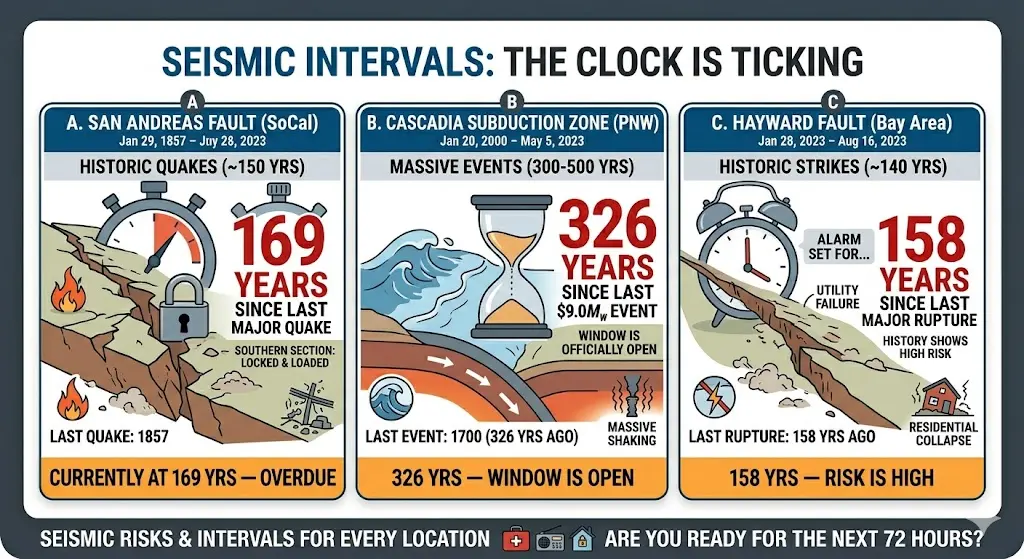
- San Andreas Fault (SoCal): Major quakes occur roughly every 150 years. The last one was in 1857. We are currently at 169 years—the southern section is “locked and loaded.”
- Cascadia Subduction Zone (PNW): Massive $9.0$ $M_w$ events happen every 300 to 500 years. The last one was in 1700 (326 years ago). The window is officially open.
- Hayward Fault (Bay Area): Historically strikes every 140 years. The last major rupture was 158 years ago.
2. History’s Warning: Significant US Earthquakes
These events shaped our modern understanding of seismic preparation:
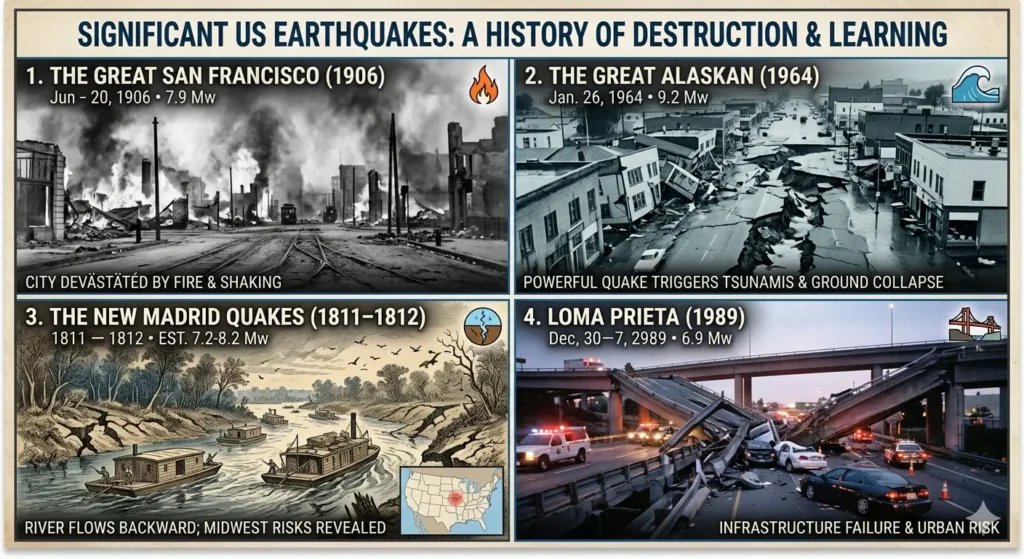
- The Great San Francisco (1906): $7.9$ $M_w$. Proved that fires and infrastructure collapse are often more dangerous than the shaking itself.
- The Great Alaskan (1964): $9.2$ $M_w$. A reminder that coastal residents must have a Go-Bag ready for immediate Tsunami evacuation.
- The New Madrid Quakes (1811–1812): Up to $8.2$ $M_w$. Proof that the Midwest is not immune to massive seismic shifts.
- Loma Prieta (1989): $6.9$ $M_w$. Highlighted the danger of double-decker highways and the importance of home furniture stabilization.
3. Survival Scenarios: What to Do Next Time
When the shaking starts, you won’t have time to read a manual. Memorize these four scenarios now:
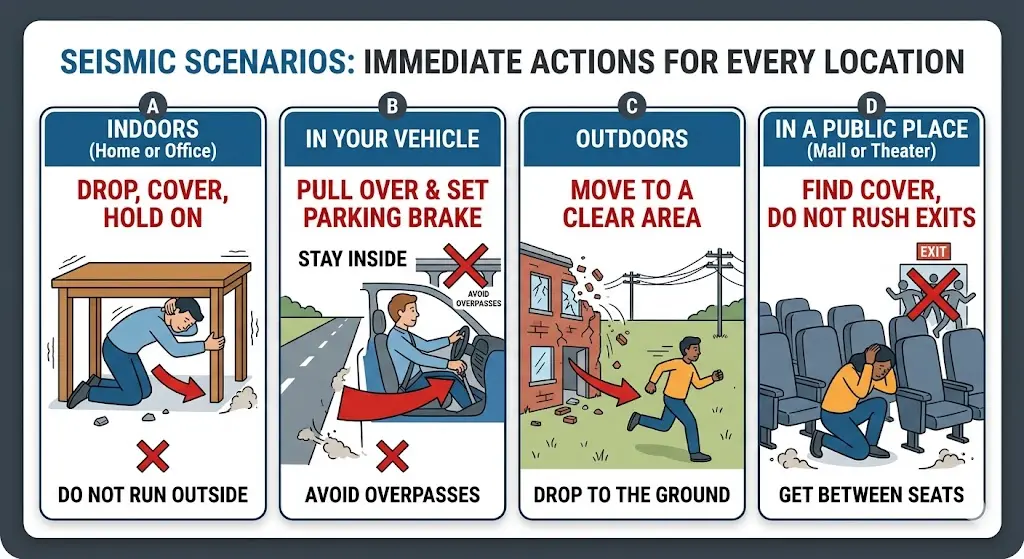
Scenario A: If You Are Indoors
- Action: Drop, Cover, and Hold On.
- Stay Put: Move as little as possible. Most injuries occur when people try to run outside.
- Avoid: Kitchens and doorways. Get under a sturdy desk or table instead.
Scenario B: If You Are Driving
- Action: Pull Over and Set the Parking Brake.
- Caution: Avoid stopping under bridges, overpasses, or power lines. Stay inside your vehicle until the shaking stops.
- The Car Rule: If you are driving a low-profile car, watch for new cracks or “sinkholes” in the asphalt after the quake before moving again.
Scenario C: If You Are Outdoors
- Action: Move to a Clear Area.
- The Danger: The greatest threat outdoors is falling debris from building facades (glass, bricks, signs). Move away from buildings and utility wires, then drop to the ground.
Scenario D: If You Are in a Public Place
- Action: Cover, Do Not Rush Exits.
- Avoid Stampedes: Do not join the frantic rush for the exit; you will be safer seeking immediate cover.
4. The First 10 Minutes: Post-Quake Checklist
The shaking has stopped, but the danger hasn’t. Follow these steps immediately:
- Check for Injuries: Tend to yourself first, then others.
- Sniff for Gas: If you smell gas or hear hissing, shut off the main valve immediately.
- Radio On: Use your Hand-Crank Solar Radio for emergency broadcasts. Cell towers will likely be jammed or down.
- Expect Aftershocks: If your building is damaged, evacuate to an open area immediately. Aftershocks can collapse already weakened structures.
Conclusion: Survival is a Choice
History tells us that the “Big One” isn’t a possibility—it’s a certainty. The difference between being a statistic and being a survivor is your level of preparation.
Are you ready for the next 72 hours?
Check out our 72-Hour Survival Guide to build your kit, or browse our Recommended Gear to secure your home today.